

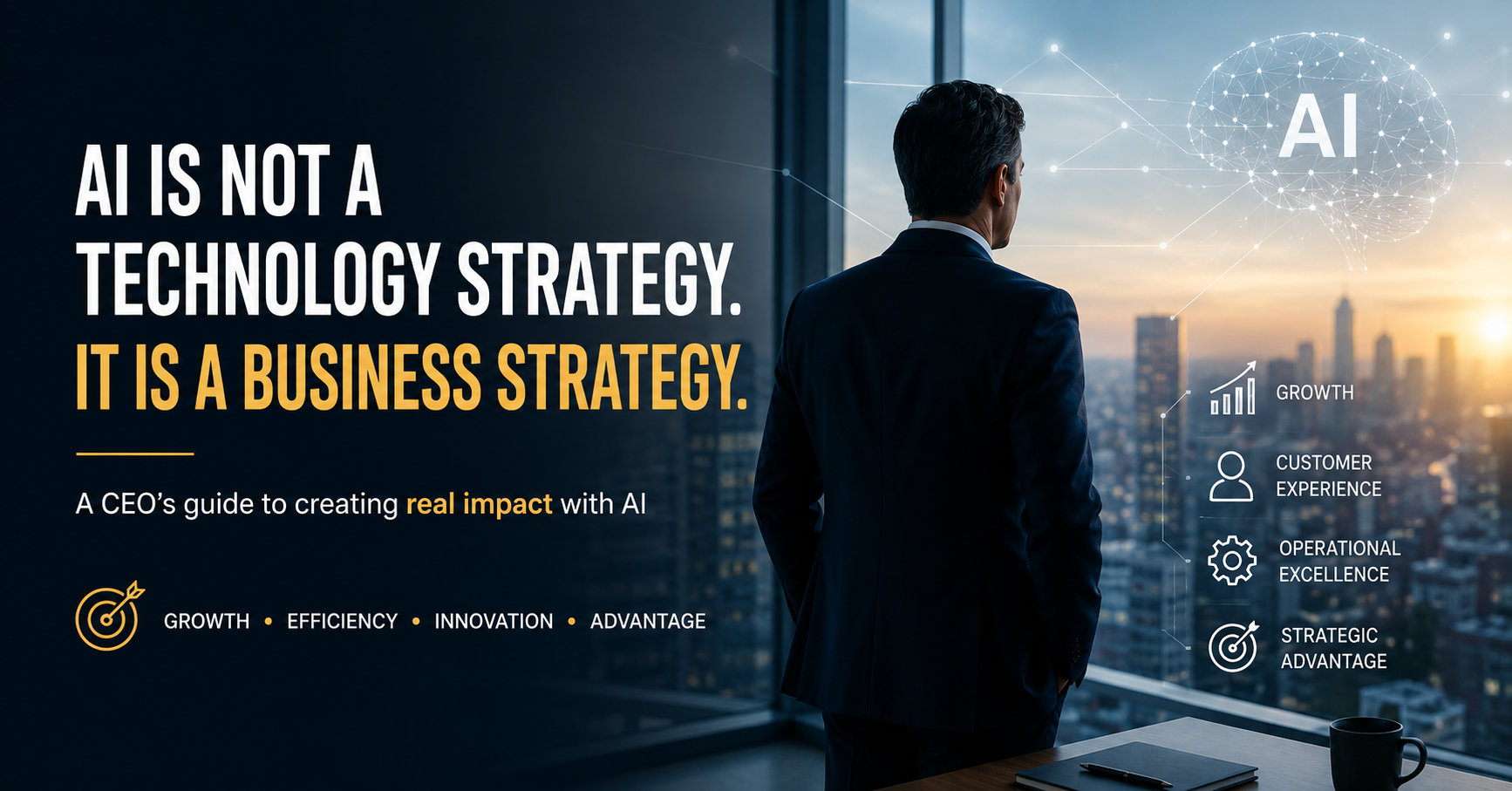
Are we actually building an AI strategy? Or are we just bolting AI onto the technology strategy we already had? Those aren’t the same thing.
The pace over the last couple of years has been fast. Boards are asking questions. CEOs want to know what rivals are up to. Teams are running pilots. Employees are quietly experimenting with copilots on their own. There’s a lot of activity, but a lot of it is pointed in the wrong direction.
The conversation almost always starts with the tech.
Which model? Which platform? Build or buy? Where can we drop in generative AI? What can we automate? Who to partner with?
These are fair questions however they are just not the first ones. The first questions are should always be about the business?
Where do we want to grow? Where are we losing customers? Where are margins getting squeezed? Where do decisions crawl when they should move fast? Where are talented people stuck doing low-value work? And the uncomfortable one: what if the way we’ve always done things simply isn’t the best way anymore?
That’s where AI gets interesting.
I don’t think the real value is making today’s work faster. That’s useful, but it’s only the start. The bigger opportunity is rethinking how the business actually works.
Take Sales for example Sure, AI can draft the emails and summarize the calls. But the bigger shift is using data, buying behavior, and market signals to change how the whole team finds and prioritizes opportunities in the first place. Can AI help us identify the opportunity at the right time and approach the client with the right solution.
Here’s the thing. A CEO doesn’t need to become an AI expert. You don’t need to track every model release or know the technical guts of each system. But you do need to know what AI could mean for your business, and to keep asking whether an investment is solving a real problem or just keeping up with the neighbors. Are you building a capability, or collecting tools?
This is why AI has to be part of the main conversation. It belongs next to growth, profitability, customer experience, risk, and talent, not off in a corner labeled “technology.” The moment AI can change how you win customers, price services, or make decisions, it stops being an IT topic and becomes a strategy one.
And access won’t save you. Your competitors can buy the same models and platforms you can. The edge comes from what you do with them. How well do you know your customers? How good is your data? How fast can you redesign a process, and get people to actually work the new way? Advantage lives in execution, not access.
I’d also be careful about measuring success by counting pilots. A company can run 50 AI initiatives and still not have a strategy. The better test: are those efforts tied to a handful of outcomes that actually matter, like revenue, margin, loyalty, speed, risk, differentiation? If you can’t connect the work to any of them, that’s worth sitting with.
None of this means technology leaders matter less. If anything, they matter more. But AI can’t live entirely with the CIO or CTO. The business has to own the outcomes. The CEO sets the ambition. The board understands the implications. Technology makes it possible, and the organisation has to be willing to change.
That last part is the hard one.
Handing someone an AI tool is easy. Changing how they work is not. Building a model is easy. Changing a decision-making process is not. Running a pilot is easy. Scaling it across a messy, complicated organization is hard.
So the next phase of AI won’t really be about experimentation. It’ll be about leadership. The companies that get this right won’t be the ones spending the most. They’ll be the ones asking better questions. Not just “what can this technology do for us?” but “what should we do differently now that it exists?”
For a CEO, this was never about adoption. It’s about deciding what kind of company you want to build over the next three to five years.
So the question isn’t “How do we adopt AI?”
It’s the bigger one. If AI is going to reshape our industry, how do we want to change our business before someone else changes it for us?
That, to me, is the real AI strategy.
AI is a business strategy. While it runs on technology, its real impact is on how a company grows, competes, prices, serves customers, and makes decisions which makes it a strategic issue, not just an IT one.
A CEO doesn’t need deep technical expertise. They need to know what AI could mean for the business, ensure investments solve real problems rather than chase trends, and decide what the company should do differently now that AI exists.
Many companies measure success by the number of pilots rather than business outcomes. A company can run 50 initiatives and still lack a strategy. The ones that succeed tie AI to a few outcomes that matter revenue, margin, loyalty, and speed.
The business should own the outcomes. The CEO sets the ambition, the board understands the implications, and technology makes it possible but AI can’t sit entirely with the CIO or CTO.