

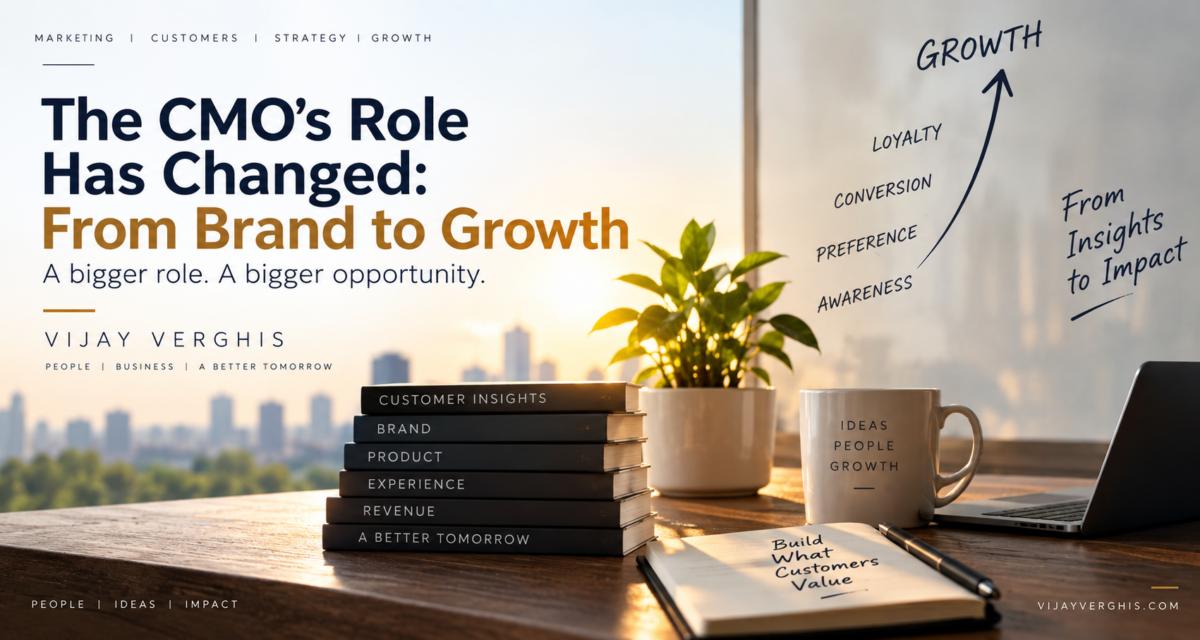
The CMO today sits in a unique position within the organisation. They are close to the customer, close to the market and increasingly close to the commercial decisions that determine growth. This makes the CMO one of the CEO’s most important allies in building the next phase of the business. I believe the CMO is moving from brand custodian to growth architect.
Growth starts outside the organisation. It starts with understanding what is changing in the market, what customers value, where their expectations are moving and where competitors are creating an advantage. The CMO has traditionally been closest to these signals. The opportunity now is to bring that outside-in perspective into the heart of business strategy.
The best CMOs are no longer looking at marketing as a collection of campaigns and channels. They are looking at the entire commercial journey. What customers need influences the proposition. The proposition influences the product and experience. Sales converts that promise into a relationship, while what happens after the sale determines whether the customer stays, grows with the company or recommends it to others.
When those pieces are connected, marketing stops being a support function and becomes a growth function.
This is also why the CMO can be such a powerful ally to the CEO.
The CEO has to look across the entire organisation. The CMO brings something particularly valuable to that conversation: a deep understanding of the market from the outside in. They can see changes in customer behaviour, shifts in perception, emerging competitors and unmet needs before they necessarily appear in a financial report.
That perspective can help the CEO make better choices about where the company should invest, which markets to pursue, which customers matter most and where the proposition needs to evolve.
But being close to the customer is only half of the equation.
The modern CMO also needs to understand the economics behind growth. Revenue, margins, customer acquisition, retention, lifetime value, pricing and sales effectiveness need to become part of the marketing conversation. It is not enough to know that a campaign performed well. The CMO needs to understand whether the activity created meaningful commercial value.
This is where the relationship between the CEO and CMO becomes particularly powerful. The CEO brings the enterprise view. The CMO brings the customer and market view. When those perspectives come together, the organisation has a much stronger basis for making growth decisions.
The CMO can also act as a bridge across functions that naturally tend to operate separately. Product may be focused on what can be built. Sales may be focused on what can be sold. Technology may be focused on what can be enabled. Finance may be focused on what can be funded.
The CMO can help connect those perspectives back to the customer and the market.
That is the real meaning of a growth architect.
It is not about the CMO owning growth. No single function owns growth. It is about helping the organisation understand how the different parts of the business come together to create it.
AI makes this even more important.
Marketing teams can now create content, analyse customer data, personalise experiences and optimise campaigns at a speed that was difficult to imagine a few years ago. As these capabilities become more common, the advantage will shift away from simply doing more marketing.
The advantage will come from making better decisions.
Knowing where to compete. Knowing which customers to prioritise. Understanding what the market will value next. Building propositions that create preference. Using technology and AI where they create genuine customer or commercial advantage.
Those are leadership decisions, not marketing tasks.
The CMO therefore has an opportunity to become much more valuable to the CEO, not by becoming another senior executive, but by bringing a stronger understanding of the customer into every major growth decision.
The brand still matters. Creativity still matters. Communication still matters, However the role has expanded.
The CMO is increasingly the person who connects what is happening outside the organisation with what needs to happen inside it.
That is a powerful position.
Because ultimately, growth is not created by marketing alone. It is created when an organisation understands its customers better, makes sharper choices, builds the right proposition and delivers an experience that earns the right to grow.
The CEO sets the ambition. The CMO can help ensure that ambition remains connected to the market.
That is why the CMO should be one of the CEO’s closest allies in driving growth.
And that, in my view, is the real evolution of the role: from protecting the brand to architecting growth.
FAQs
A CMO growth strategy is the approach a Chief Marketing Officer takes to connect customer understanding, market opportunities, brand, product, sales and customer experience to sustainable business growth. It goes beyond campaigns and marketing activity to focus on revenue, customer value, retention and competitive advantage.
The CMO’s role has expanded from managing brand and communications to influencing broader business growth. Modern CMOs increasingly work across customer strategy, product, sales, technology, data and commercial performance, making marketing a more central part of business strategy.
The CMO brings an outside-in perspective that is particularly valuable to the CEO. They are often closest to customers, market shifts, competitors and changing expectations. When that understanding is combined with commercial thinking, the CMO can help the CEO identify growth opportunities, shape priorities and connect the organisation around the customer.
A growth-oriented CMO looks beyond marketing metrics and understands the commercial drivers of the business. They connect customer insight with proposition, product, sales, experience, retention and revenue. They also understand where marketing investment creates value and where it does not.
AI will automate and accelerate many marketing activities, including content creation, customer analysis, personalisation and campaign optimisation. This makes strategic judgement even more important. The future CMO will need to focus less on producing more marketing and more on making better decisions about customers, markets, propositions and sustainable growth.